
Table of Contents
What SpaceX Announced
SpaceX has closed $40 billion in debt financing to buy graphics processing units, the powerful chips that sit at the heart of modern artificial intelligence systems, according to Elon Musk. Musk announced the completion of the deal in a post on X on 25 October 2026, bringing to an end weeks of reporting about a financing package of that size.
The announcement matters because of its sheer scale. Forty billion dollars is an extraordinary sum for a single company to borrow for a single purpose, even in an industry that has grown used to very large numbers. It is also a measure of how central computing hardware has become to the artificial intelligence race. Companies are no longer competing mainly on clever ideas or talented teams, although both still matter. They are competing on access to machines, electricity and buildings, and on the ability to pay for them before rivals do.
Musk described the borrowing in plain terms. He said the package was primarily callable debt for graphics processor purchases that would arrive in the first two quarters of the year ahead, and that it was not a major factor for the current quarter. Callable debt, in simple language, is borrowing that the borrower can repay early under agreed conditions, which can give a company flexibility if its plans or market conditions change. The timing point also matters. If the chips arrive in the first half of next year, the spending, and the computing capacity that follows from it, will shape what SpaceX can build and offer through 2027 and beyond, rather than changing its position overnight.
Reports before the announcement had described a similar structure. Reuters reported earlier in October that SpaceX was in talks with banks and asset managers about raising about $40 billion for Nvidia artificial intelligence chips. Other reporting described a package made up of roughly $10 billion in bank loans and about $30 billion in investment-grade debt, with Apollo Global Management expected to lead the effort and other large investors, reportedly including PIMCO, involved in discussions. Those reported details help explain how a deal of this size is put together. It is rarely one lender writing one cheque. It is usually a group of institutions, each taking a share, brought together by a lead arranger.
The deal also underlines a shift in how artificial intelligence is financed. In the early years of the current AI boom, much of the money came from equity, meaning investors buying shares and sharing both the upside and the risk. Debt is different. Lenders expect to be repaid with interest, on a schedule, whether or not a particular product succeeds. That makes the lender’s judgement crucial. A lender will only commit tens of billions of dollars if it believes the borrower’s income is steady enough, and its assets valuable enough, to support repayment.
Why Lenders Backed the Deal
Musk pointed to two reasons why SpaceX was able to borrow on this scale. The first was its investment-grade status. In credit markets, an investment-grade rating signals that rating agencies and lenders regard a borrower as relatively safe, compared with riskier borrowers that must pay much higher interest rates or may struggle to borrow at all. That status does not appear by accident. It reflects a track record of revenue, a view of future cash flow, and confidence in management and governance.
The second reason Musk gave was revenue from Starlink, its satellite internet business, and from its launch business. This is an important distinction in the current market. Many companies building artificial intelligence infrastructure earn most of their money, if they earn any at all, from selling computing capacity itself. Their fortunes rise and fall with demand for that capacity. SpaceX, by contrast, has large businesses outside artificial intelligence computing. Starlink sells internet subscriptions to customers around the world, producing recurring revenue month after month. Its launch business sells rockets and launches, a service for which there is demand from governments and private customers alike. Lenders, according to Musk’s account, saw those income streams as a cushion.
That cushion argument has been central to the debate about artificial intelligence financing in 2026. As spending on data centres has soared, banks and asset managers have become more selective. They are still willing to lend very large sums, as this deal shows, but they are asking harder questions about what happens if demand cools, if chip prices fall, or if a data centre takes longer than planned to fill with paying customers. A borrower with income from outside the AI data centre market can answer those questions more convincingly than a borrower whose only income is renting out graphics processors.
There is also a practical point about collateral. Reporting on the talks described discussions about using special purpose vehicles, which are separate legal entities set up to hold assets and borrow against them, with the graphics processors themselves potentially serving as collateral. In plain terms, that structure can ring-fence the borrowing and the hardware, giving lenders a clearer claim if something goes wrong, while keeping the debt off the main company’s balance sheet in some presentations. Musk’s announcement did not dwell on those mechanics, but they are part of why large, complex deals take weeks to negotiate.
What the Money Will Buy
The money is earmarked for graphics processing units, often called GPUs, and specifically for Nvidia hardware, according to reporting on the deal. Graphics processors were originally designed to render images for video games, but they turned out to be extremely good at the parallel calculations that artificial intelligence models need. Training a large model involves performing vast numbers of similar calculations at once, and GPUs do that far faster than general-purpose computer processors.
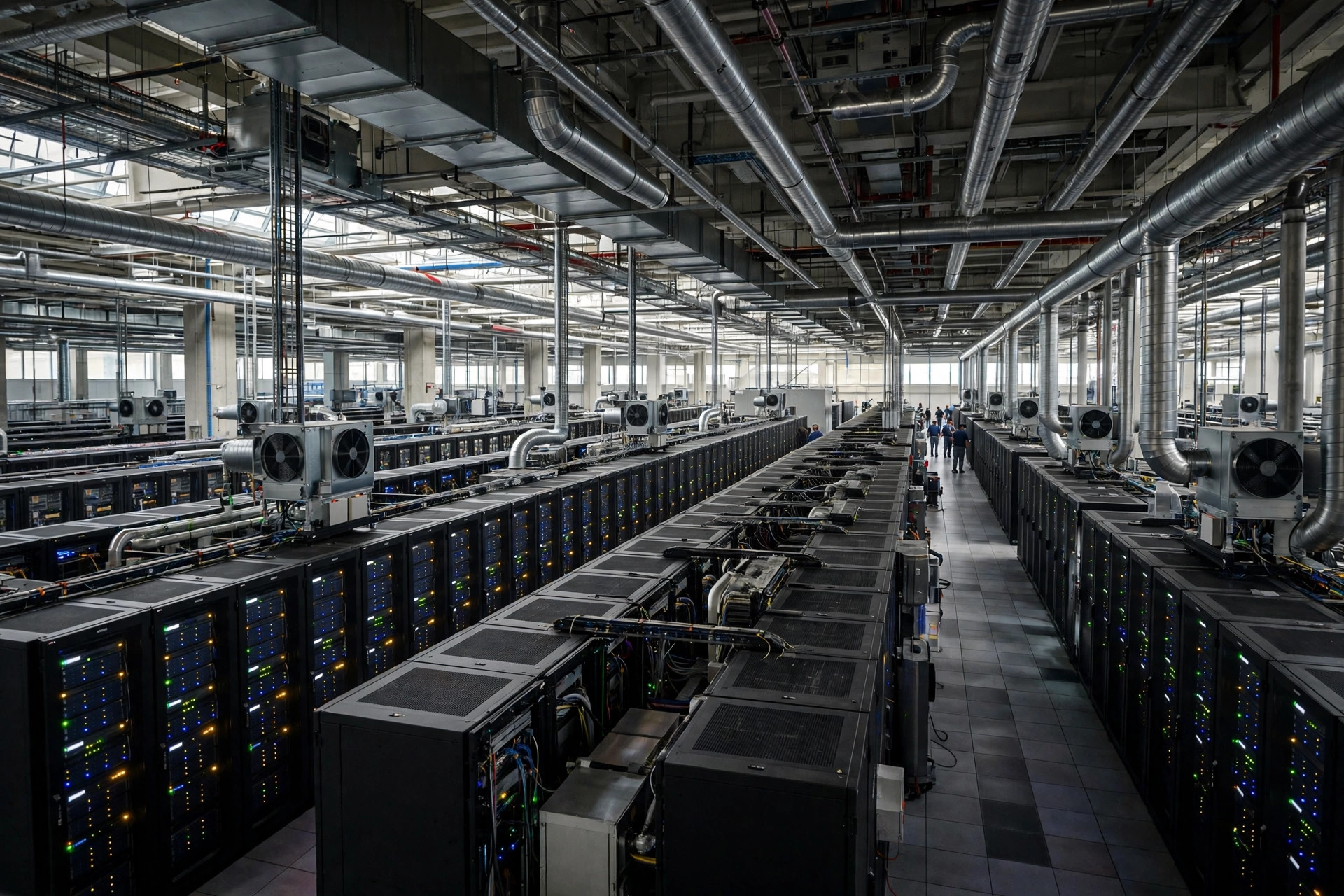
SpaceX has said it intends to build its artificial intelligence infrastructure around Nvidia hardware, and its Colossus data centre cluster is the most prominent example of that push. Data centres of this kind are not ordinary office buildings with a few servers. They are industrial-scale facilities, filled with row after row of racks, each holding many chips, connected by high-speed networking, cooled by elaborate systems, and fed by enormous amounts of electricity. Building one is a construction project. Filling one is a procurement project. Running one is an energy project. All three are expensive, and all three must be planned years ahead because of long lead times for equipment and power connections.
Musk has previously said that the Colossus 2 data centre could more than double the number of Nvidia chips it uses by December, according to reporting. Whether that timetable is met will depend on deliveries, power availability and construction, all of which have proved to be constraints across the industry. The new financing is therefore best understood not as a purchase of chips for immediate use, but as a reservation of future capacity. By borrowing now, SpaceX is seeking to secure its place in the queue for hardware that many other companies also want.
The compute will be used, according to reporting, both for internal projects and for external contracts. That dual purpose is common among large technology companies. Internal use supports their own products, from chatbots and research tools to robotics and autonomous systems. External contracts turn spare or dedicated capacity into a service sold to other companies, creating a new revenue stream. The balance between the two will shape how quickly the investment pays for itself.
A Year of Record Capital Raising
The $40 billion debt deal did not arrive in isolation. It followed a year in which SpaceX raised capital on a scale that few private companies have ever attempted. Reporting on the deal noted that SpaceX completed an $86 billion initial public offering in June 2026, and then raised a further $25 billion in bonds shortly afterwards. Taken together with the new debt package, those transactions describe a company moving very large sums of money in a short period, in pursuit of a very large ambition.
An initial public offering of that size would, on its own, be a landmark event. It turns a private company into a public one, gives early investors and employees a way to sell shares, and raises money that can be spent on expansion. A subsequent bond sale of $25 billion adds debt on top of equity, increasing the total capital available but also increasing the obligations to repay. The new $40 billion package adds a further layer, this time tied specifically to hardware purchases.
This sequence also reflects how the artificial intelligence industry’s financing has evolved. Early funding rounds were dominated by venture capital firms betting on small teams. Later rounds involved large technology companies investing in each other. Now the sums are so large that public markets, bond markets and bank lending are all involved at once. That brings more scrutiny, more disclosure, and more sensitivity to interest rates and credit conditions than the industry faced when it was smaller.
It is worth noting what SpaceX told prospective investors before its public offering. Its filing listed manufacturing its own graphics processors among the substantial capital expenditures it was undertaking, alongside other artificial intelligence and technology investments. That disclosure warned investors, in advance, that spending would be heavy. The new debt deal is consistent with that warning. It is not a sudden change of direction. It is the financing catching up with a plan that was already described in public documents.
A related project is Terafab, a chip manufacturing joint venture between SpaceX and Tesla in Austin. According to reporting, Terafab should produce its first test chip around May or June of next year, with the aim of reaching volume production by the third quarter of 2028. That project is separate from the purchase of Nvidia chips, but it points in the same direction. In the long run, SpaceX appears to want more control over its own chip supply, rather than depending entirely on outside suppliers. Building a chip factory, however, takes years and billions of dollars, which is why buying existing chips remains essential in the meantime.
The Warning About Smaller AI Firms
Alongside the announcement, Musk issued a stark warning about smaller companies in the same industry. He said that debt markets had almost entirely shut off access to money for companies that do not have substantial revenue independent of artificial intelligence data centres. He predicted widespread failures and consolidation among more than 200 so-called neocloud companies, firms that rent out graphics processor capacity without owning other infrastructure, with only a small fraction expected to survive.
That warning deserves careful reading. It is, in part, a description of a market. It is also, in part, an argument. By drawing a line between companies with diverse revenue and companies that depend solely on renting chips, Musk is explaining why SpaceX could borrow while others cannot. He is also, implicitly, predicting a shakeout that would leave larger, better-funded players in a stronger position.
Neocloud firms grew rapidly when demand for computing capacity outstripped supply. A company could buy chips, rent them out by the hour, and charge a premium because customers could not get hardware anywhere else. That model works well while demand is rising and credit is easy. It becomes fragile when supply increases, prices fall, or lenders worry that the chips bought today will be worth less tomorrow. Unlike a satellite internet business or a launch business, a pure chip-rental business has little to fall back on if rental prices drop.
Musk’s phrase about widespread failures and consolidation should therefore be treated as a prediction, not as an established fact. Predictions about shakeouts are common in technology booms, and they are sometimes right and sometimes early. What is not in doubt is the direction of credit conditions described in reporting. Banks and investors have become more selective about artificial intelligence projects, even as they continue to fund the largest and most established borrowers. That selectivity is itself a force for consolidation, because it makes it harder for smaller firms to refinance or expand.
Why Chips Have Become the Bottleneck
To understand why a single company would borrow $40 billion for chips, it helps to understand why chips became the bottleneck in the first place. Artificial intelligence models have grown larger and more capable, but that growth has required exponentially more computing power. Training a frontier model can involve thousands of chips running for weeks or months. Serving that model to millions of users, answering questions in real time, requires further capacity, day after day.
Supply has struggled to keep up. Nvidia, the dominant supplier of the most advanced training chips, can only manufacture a limited number each year, because chip fabrication is itself a complex, capital-intensive process involving a small number of advanced factories. Other suppliers are growing, but catching up takes time. Customers therefore compete for allocations, and securing a large allocation can be as strategically important as designing a better model.
That competition extends beyond chips to power and land. A large data centre can consume as much electricity as a small city. Utility companies need time to build new generation and transmission capacity. Local communities sometimes object to new facilities because of their water use, noise, or impact on electricity prices. Permits, grid connections and cooling systems all add delays. In that environment, money alone does not guarantee speed, but a lack of money guarantees slowness.
Morgan Stanley has estimated, according to reporting, that the broader artificial intelligence infrastructure market will require approximately $1.5 trillion of external financing by 2028. That figure, if broadly correct, puts the SpaceX deal in perspective. Forty billion dollars is very large for one company, but it is a fraction of the total that the industry as a whole may need. It also explains why investors and regulators are paying close attention to how this borrowing is structured, and to whether the returns will justify it.
Nvidia has also been working with major financial institutions to expand the pool of capital available for artificial intelligence infrastructure. Reporting noted that in August, Nvidia partnered with Apollo, BlackRock, Blackstone, Brookfield, Goldman Sachs and KKR on financing platforms intended to mobilise more than $500 billion for such projects. That partnership illustrates how intertwined the chip maker, the lenders and the buyers have become. The same institutions may be involved as investors, lenders and advisers across several deals at once.
The Risks Behind the Borrowing
Every large borrowing carries risks, and this one is no exception. The most obvious risk is that the investment does not generate enough return to cover the cost of borrowing. SpaceX’s third-quarter results, as reported by Reuters, provide some context. Revenue climbed 161 percent to $14.58 billion for the three months ended 30 September, compared with a year earlier. That is rapid growth by any standard. At the same time, capital expenditure nearly tripled to $19.6 billion in the same period. Spending is growing faster than revenue, at least in that quarter, which is typical for a company building infrastructure ahead of demand, but it cannot continue indefinitely without returns catching up.
A second risk is technological change. Graphics processors improve quickly. A chip bought today may be superseded within two or three years by a faster, more efficient model. If prices for older chips fall sharply, the value of the collateral backing the debt could fall too. That is one reason why the callable structure and the timing of deliveries matter. A company wants flexibility to adjust its plans if technology or market conditions shift.
A third risk is concentration. Building infrastructure around a single supplier, even a dominant one, creates dependence. If that supplier faces production problems, export restrictions, or pricing changes, its customers feel the effects immediately. SpaceX’s long-term interest in manufacturing its own chips, through projects such as Terafab, can be read as a hedge against that concentration, but such a hedge will take years to mature.
A fourth risk is broader credit conditions. Interest rates, investor sentiment and the health of the banking system all affect how easy it is to refinance debt when it comes due. Callable debt gives the borrower some flexibility, but it does not remove the obligation to repay. If credit markets tighten sharply, even strong borrowers can face higher costs. That is why lenders pay so much attention to recurring revenue and investment-grade status. Those qualities do not make a borrower immune to a downturn, but they do make it more resilient than borrowers without them.
Finally, there is the risk of overbuilding. Technology history is full of booms in which too much capacity was built too quickly, followed by a painful correction. Railways, telecoms networks and dot-com era fibre networks all went through versions of this cycle. Artificial intelligence infrastructure may be different, because demand for computing continues to grow, but the possibility of a correction cannot be ruled out. Musk’s own warning about smaller firms suggests that he, too, sees that possibility, even if he believes SpaceX is on the stronger side of the divide.
What to Watch Next
Several things will show whether this bet pays off. The first is delivery. If the graphics processors arrive in the first two quarters of next year as described, SpaceX will be able to expand its computing capacity on schedule. Delays would not necessarily doom the plan, but they would push back the revenues that are supposed to justify the borrowing.
The second is utilisation. It is not enough to own chips. They must be used productively, either for internal products that attract users and revenue, or for external customers willing to pay for capacity. Watch for announcements about new data centre capacity coming online, new services powered by that capacity, and any large customer contracts that are disclosed.
The third is financial performance. Future quarterly results will show whether revenue continues to grow fast enough to support rising capital expenditure, and whether the company can manage its debt while continuing to invest. Investors will also watch for any further borrowing, and for the terms on which it is raised. If future deals are raised on similar or better terms, that will signal continued lender confidence. If terms worsen, it will signal caution.
The fourth is the fate of smaller competitors. If Musk’s prediction proves correct, the coming year may bring mergers, failures and asset sales among neocloud firms. Those events, if they happen, will be reported in their own right, and they will test whether the market is consolidating around a few large players or whether new models emerge that can survive with less capital.
The fifth is the broader policy environment. Governments around the world are increasingly interested in where artificial intelligence infrastructure is built, who controls it, and how much energy it consumes. Export controls on advanced chips, energy policy, and competition rules could all affect the pace and geography of future investment. None of those factors will be decided by a single financing deal, but they will shape the context in which that deal plays out.
For readers, the key takeaway is simpler than the financial details. Artificial intelligence is no longer just a software story. It is an infrastructure story, involving factories, power stations, lenders and long-term bets. The $40 billion deal is a reminder of how much capital that story now requires, and of how unevenly that capital is distributed. Some companies can borrow at scale because they have diverse, recurring revenue. Others, by Musk’s account, are finding the credit window closing. That divide, more than any single product launch, may define the next phase of the artificial intelligence race.
