
Table of Contents
- The concession that changed the night
- What the preliminary numbers say — and what they do not
- How a station tragedy became a national movement
- From street protests to a parliamentary list
- Why turnout and the mood in Belgrade mattered
- The Student List’s broad coalition and its loose ends
- What Vucic’s camp loses — and what it keeps
- The road to a new government
- Europe, Russia and Kosovo: the questions that remain
- What this result does — and does not — prove about democracy
- What to watch next
- Why Serbia’s story is being watched beyond the Balkans
The concession that changed the night
Belgrade changed in a matter of minutes on election night. For months, Serbia’s snap parliamentary election had been described as close, tense and hard to call. Then Aleksandar Vucic, the country’s long-serving leader, appeared before supporters and journalists and said, in plain terms, that his camp had lost. According to reports of his remarks, he said that based on a stratified sample it was clear that his side had lost the election, and that the Student List had won.
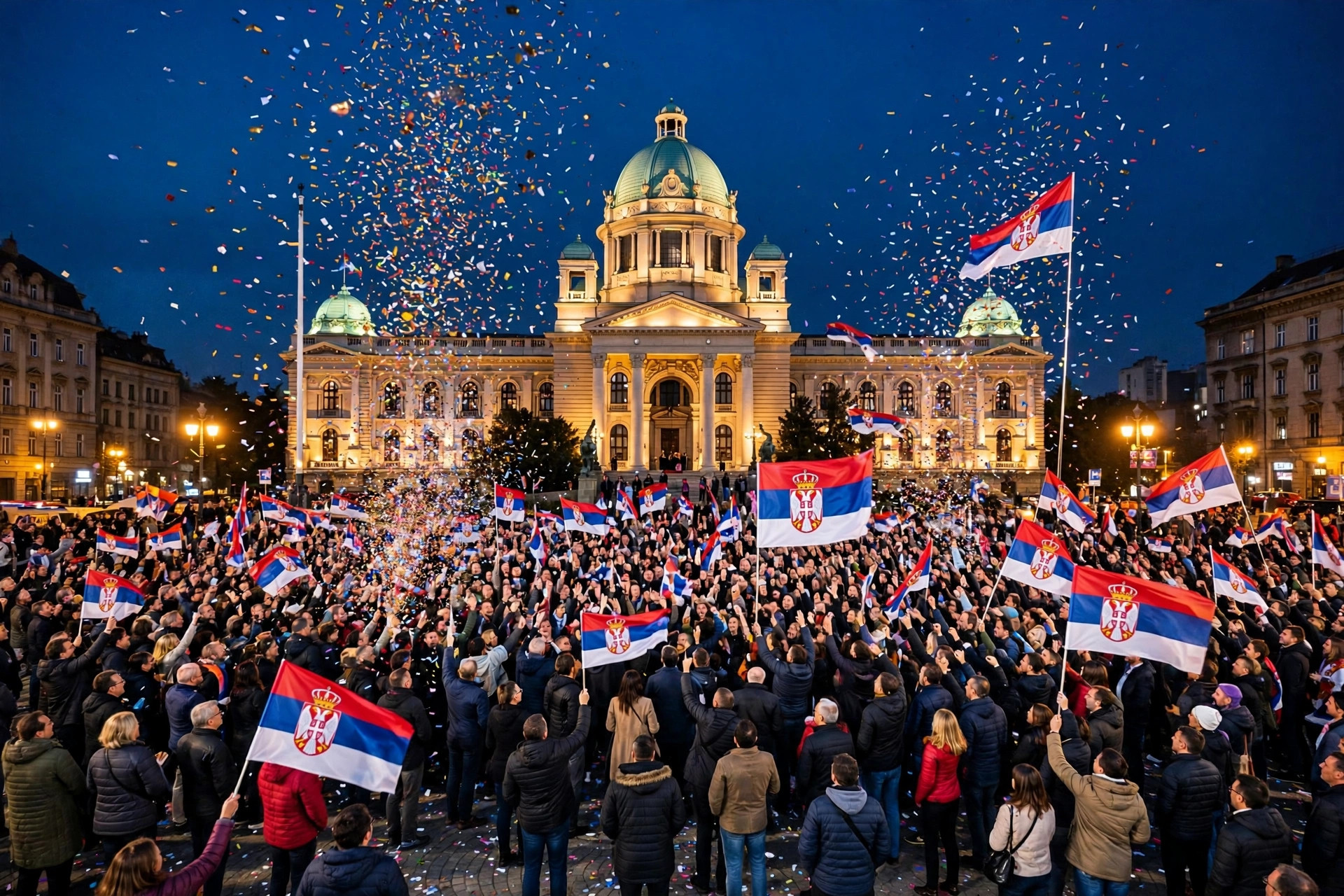
That single admission transformed the evening. Crowds gathered in central Belgrade and other cities, celebrating a result that many voters had hoped for but few had dared to predict with confidence. People waved flags, embraced strangers and chanted slogans that had echoed through two years of protests. For a movement that began with students demanding accountability, election night felt like a crossing from protest into power.
Yet the celebration also carried a note of caution. The results cited on election night were preliminary projections, not the final certified count. Serbia’s electoral commission had still to confirm the outcome, and the formal allocation of seats would follow the official process. The concession therefore answered the biggest political question of the night — who had won — while leaving the legal and institutional steps still to be completed.
What the preliminary numbers say — and what they do not
The preliminary figures reported after the polls closed pointed to a clear, not marginal, victory for the Student List. Vucic himself put the student-backed list at between 135 and 140 seats in Serbia’s 250-seat National Assembly, against about 105 seats for his own camp. That range, if confirmed, would comfortably clear the 126 seats needed for a parliamentary majority.
Independent monitoring and polling estimates pointed in the same direction, though the exact totals varied slightly between sources. One monitoring organisation, CRTA, was reported to have put the Student List at about 51.47 percent of the vote, with Vucic’s United Serbia coalition at about 40.42 percent. Pollsters CESID and Ipsos were reported to have produced similar projections, with the Student List on roughly 138 to 141 seats depending on the update cited. Another updated projection put the Student List at 52.9 percent and 141 seats, with Vucic’s list at 38.8 percent and 103 seats.
Those differences matter less than the direction they share. Every major preliminary estimate placed the Student List above the majority threshold and Vucic’s camp well below it. At the same time, readers should treat the precise seat counts as provisional until the Republic Electoral Commission publishes final results. Minority lists were also expected to take a small number of seats, with reports mentioning the Alliance of Vojvodina Hungarians, an Albanian list and another minority party, but the overall picture remained a two-bloc parliament dominated by the Student List and the Serbian Progressive Party camp.
The size of the margin surprised many observers. Pre-election polling had suggested a much closer race, with the two main lists within a few percentage points of each other in some surveys. The preliminary result therefore did more than confirm a change of government. It suggested that late-deciding voters, turnout, or both, moved decisively in the final days, in a way that polls had not fully captured.
How a station tragedy became a national movement
To understand why this election mattered so much, it is necessary to go back to 1 November 2024. On that day, a concrete canopy at the railway station in Novi Sad, Serbia’s second-largest city, collapsed, killing 16 people. The station had recently been reconstructed, and the disaster quickly became far more than a local tragedy in the public mind.
Students and other citizens demanded answers. They wanted to know who was responsible, whether corruption or negligence had played a part in the reconstruction, and whether public documents about the project would be made available. What began as mourning and a demand for accountability grew into a sustained protest movement. Students blocked university faculties, organised silent tributes at the exact time of the collapse, and held daily blockades that became a symbol of the wider campaign.
Over time, the movement widened. Teachers, farmers, lawyers, healthcare workers, artists and ordinary citizens joined protests in cities and towns across Serbia. By March 2025, hundreds of thousands of people were reported to have taken part in a major demonstration in Belgrade, one of the largest protests in Serbia’s recent history. The students’ message, repeated again and again, was that public institutions should answer to citizens, not protect powerful interests.
The government, for its part, rejected the charge that it was responsible for the disaster in the way protesters claimed, and Vucic repeatedly described the movement as an attempt to overthrow him with foreign backing. That claim was fiercely denied by the students. The dispute over the Novi Sad collapse therefore became a dispute over something larger: trust in institutions, the independence of prosecutors and courts, freedom of the media, and whether ordinary people could hold power to account.
From street protests to a parliamentary list
For much of their first year, the students insisted they were not a political party. Their strength lay in collective decision-making through student plenaries, in which participants debated and voted rather than following a single charismatic leader. That model gave the movement credibility, but it also raised a practical question. Protests alone, however large, do not pass laws, appoint ministers or control budgets.
The answer was the Student List, formally known as Students Win, a broad electoral list that brought together students, professors, scientists, doctors, workers, artists and other citizens. Reports before the election described a slate of 250 parliamentary candidates selected through consultations and deliberations involving thousands of students. The aim was to turn a protest coalition into a parliamentary force without simply recreating a traditional party machine.
The list also broadened its programme beyond the original demands. Reports described an eleven-point programme that included promises such as free textbooks for primary and secondary school pupils, alongside commitments on accountability, the rule of law and institutional reform. Those promises were designed to appeal to families worried about everyday costs as well as voters focused on democratic reform.
This transition was not without tension. A movement built on horizontal democracy had to choose candidates, agree priorities and campaign as a single list. Critics asked whether such a diverse coalition could govern coherently. Supporters answered that diversity was the point: the list was meant to represent a cross-section of Serbian society rather than a narrow political elite. Election night gave the supporters the first part of their answer. Governing will test the second part.
Why turnout and the mood in Belgrade mattered
Election day was marked by high turnout and long queues, including among diaspora voters abroad. Reports described waits of up to three hours in London, and large crowds gathering in Belgrade as results emerged. The mood on the streets after Vucic’s concession was euphoric. Residents were reported to have danced, hugged and chanted “Gotov je!”, meaning “He’s finished!”, a slogan with echoes of the October 2000 protests that ended the rule of Slobodan Milosevic.
That historical echo matters. For many Serbians, 2000 was the last moment when mass mobilisation changed the country’s political direction so dramatically. The comparison is not exact — Serbia in 2026 is not Serbia in 2000, and the Student List is not a single opposition leader — but the emotional resonance helps explain why election night felt historic rather than routine.
Turnout also matters for legitimacy. A high turnout makes it harder for any side to claim that the result reflects only a narrow, motivated minority. It also increases the pressure on the winners to deliver, because a large electorate has now invested its hopes in change. The students understood that pressure. Their leaders spoke on election night not of revenge, but of moving towards what one leader, Ilija Srdanovic, described as a civilised and better Serbia. Another prominent candidate, Professor Radomir Saicic, was reported to have called the result a victory of courage over fear and of hope over apathy, and to have stressed that the victory belonged to all citizens, not to any one person.
The Student List’s broad coalition and its loose ends
One of the most important features of the Student List is also one of its greatest uncertainties: it is a coalition, not a uniform party. Its participants span the political spectrum, from left to centre to right, united more by opposition to corruption and by a demand for functioning institutions than by agreement on every policy question.
That breadth was an electoral asset. It allowed the list to appeal to voters who might disagree about the European Union, Kosovo or economic policy, but who shared frustration with the way power had been exercised. It also means that governing will require constant negotiation inside the list itself. Questions that could be postponed during a campaign — who becomes prime minister, how ministries are divided, how quickly to pursue judicial reform, and how to handle the economy — will now need concrete answers.
The list’s programme also contains areas where its candidates have taken different positions, particularly on foreign policy. Some reports before the election noted that candidates had taken a hard line on Kosovo, had proposed reviewing agreements reached under European Union auspices, and had floated a referendum on EU membership within six months of taking office. Others emphasised continuity and reform. Those differences were not resolved on election night, and they will shape how the new government is viewed in Brussels, Moscow and Pristina.
None of this diminishes the scale of the victory. It simply means that winning a parliamentary majority is the beginning of a governing challenge, not the end of it. The Student List must now prove that a movement built for protest can also build institutions, pass budgets and manage a state.
What Vucic’s camp loses — and what it keeps
For Vucic and the Serbian Progressive Party, the result ends a 14-year hold on power. That is a profound change in a country where one party and one leader have dominated politics for so long. Vucic had resigned as president before the election to seek a return as prime minister, according to reports, and his camp had campaigned on continuity and stability. The preliminary result rejected that offer.
Yet defeat in a parliamentary election does not erase the party’s presence. With roughly 103 to 105 seats in preliminary projections, the SNS camp would remain the largest opposition force in parliament, with a substantial base of voters behind it. It would retain experienced politicians, local networks and a media presence, even if it no longer controls the government. How it behaves in opposition — whether it accepts the new government’s legitimacy, cooperates on institutional reforms, or seeks to obstruct them — will shape Serbia’s stability in the months ahead.
Vucic’s own concession may help in that regard. By acknowledging defeat early, based on a sample rather than waiting for the final count, he reduced the risk of an immediate dispute over who had won. He also, according to reports, blamed independent media and alleged interference by unnamed European countries and an American deep state for the loss. Those claims were not supported by evidence in the reports cited, and they point to a continuing dispute over the campaign environment. But the concession itself, whatever the rhetoric around it, gave the country a clearer path to a transfer of power than a contested refusal would have done.
The road to a new government
The next steps are procedural, but they are not automatic. Serbia’s electoral commission must confirm the final results and allocate seats. Parliament must then convene, and a government must be formed that can command a majority. With a projected majority of its own, the Student List would not need to rely on a formal coalition with another major party, though it may still seek broader support for constitutional or institutional reforms that require larger majorities.
Reports before the election suggested that a challenger government might seek to establish an interim, expert-led reform administration, focused on strengthening judicial independence, revising electoral legislation and tackling corruption. Whether the Student List follows that model, forms a more conventional cabinet, or combines the two approaches remains to be seen. The choice will signal how quickly it intends to move, and how much it prioritises institutional reform over day-to-day administration.
There are also practical constraints. Ministries, security services and public enterprises have been shaped by years of SNS rule. A new government will need to appoint officials, review contracts and budgets, and establish control over institutions without triggering a crisis in public services. It will also need to handle the presidential election scheduled for December, since Vucic’s resignation as president leaves the head of state to be chosen in the coming months. That election could become a second test of the country’s new political balance.
Europe, Russia and Kosovo: the questions that remain
International reaction to the result was swift and warm, particularly from European leaders. European Commission President Ursula von der Leyen was reported to have congratulated the Student List and noted record turnout. EU enlargement commissioner Marta Kos was reported to have said that Serbia had made its voice heard after nearly two years of protests for democracy, the rule of law and the fight against corruption, and that the door to the EU was open.
That welcome, however, comes with unresolved questions. Serbia’s EU accession process has been stalled for years, blocked by concerns over the rule of law, limited alignment with EU sanctions, including those against Russia, and the stalled normalisation process with Kosovo. A change of government does not automatically resolve those issues, especially if the new government is divided on EU membership itself.
Russia is another complicating factor. Moscow had offered explicit support to Vucic’s government and had portrayed the protests as a Western-backed colour revolution, according to pre-election analysis. The Student List has signalled, in some reports, continuity in relations with Russia, while also seeking closer cooperation with Europe on democratic reform. Balancing those pressures will be difficult, and the new government’s first foreign policy statements will be watched closely.
Kosovo remains the most sensitive issue of all. Any Serbian government must navigate the normalisation dialogue, domestic political opinion, and international expectations. The Student List’s reported proposals to review existing agreements and to consider a referendum on EU membership could slow or complicate that process, even as democratic reform might renew cooperation with Brussels in other areas. For now, foreign policy is the biggest unknown in the new government’s programme, and it may remain so until the cabinet is formed and its priorities are stated clearly.
What this result does — and does not — prove about democracy
It is tempting to read Serbia’s election as a simple story of democracy triumphing over authoritarianism. That reading captures part of the truth, but it misses important nuance. The election took place amid reports of intimidation, violence and procedural problems. Election monitors CRTA were reported to have recorded pressure on voters, election workers or observers at 29 percent of the polling stations they monitored. They also reported ballot photographing, which can compromise vote secrecy, and filed a report over suspected vote-buying and carousel voting in Veternik.
Those are serious findings, and they should not be ignored. At the same time, they do not, on their own, establish that the overall result was invalid, particularly given the size of the projected margin and Vucic’s own concession. Pre-election assessments had also raised concerns about pressure on voters, use of public resources and a blurred boundary between state and ruling party. The campaign environment was therefore contested, even if the outcome was clear.
What the result does prove is narrower but still significant. It shows that mass mobilisation, sustained over two years, can be translated into electoral victory, even against an entrenched incumbent. It shows that a movement without a single dominant leader can organise, campaign and win. And it shows that voters, when given a clear alternative, can use an election to change the direction of their country. Those are not small achievements, and they are why the result is being discussed far beyond Serbia’s borders.
What to watch next
Several developments will determine whether election night becomes a lasting turning point or a brief interruption. The first is the final certified result. Any significant change from the preliminary projections would need to be explained transparently, and the electoral commission’s credibility will be tested by how it handles complaints and recounts.
The second is government formation. Watch who is proposed as prime minister, how ministries are allocated, and whether the new cabinet includes experts, politicians or a mix of both. Watch also for early decisions on judicial appointments, media regulation and anti-corruption investigations, which will signal whether institutional reform is a priority or a slogan.
The third is the presidential election in December. That contest will test whether the Student List’s momentum extends beyond parliament, and whether Vucic’s camp can regroup around a new candidate. It will also test whether Serbia’s political system can handle two major transitions in quick succession without instability.
The fourth is the economy. Serbia faces familiar pressures: inflation, public spending, investment and jobs. A new government that focuses only on institutional reform while neglecting everyday economic concerns risks losing the broad coalition that elected it. Conversely, a government that delivers visible improvements in public services, education and transparency may consolidate its support.
The fifth is the response of institutions that have long been aligned with the previous government, including parts of the security services, judiciary and public media. A peaceful, orderly transfer of power in those institutions is essential. Any attempt to resist or sabotage the new government would test Serbia’s democratic resilience in a different way from the election itself.
Why Serbia’s story is being watched beyond the Balkans
Serbia is a relatively small country, but its election resonates across Europe and beyond. For the European Union, it raises the prospect of a new partner in the Western Balkans, one that might be more committed to the rule of law and democratic reform, but also one whose foreign policy is not yet settled. For neighbouring countries, it offers a case study in how student movements can challenge entrenched power without a single leader or a traditional party structure.
For younger voters elsewhere, the story may feel familiar. Many democracies face complaints about corruption, captured institutions and a sense that politics serves insiders rather than citizens. Serbia’s students did not solve those problems overnight, and they have not yet proven they can govern. But they did something that many movements struggle to do: they stayed organised for two years, they built a broad coalition, they contested an election, and they won.
That is why the celebrations in Belgrade mattered, and why the work that follows will matter even more. Election night was a moment of joy for many Serbians, and a moment of reckoning for a political order that had seemed immovable. The next chapter — forming a government, reforming institutions, choosing a president, and deciding Serbia’s place in Europe — will determine whether that joy becomes lasting change. For now, Serbia has a new parliamentary majority, a conceded defeat, and a country waiting to see what its students will do with power.
