
Table of Contents
- A Comeback That Broke Two Records
- From First-Round Defeat to Runoff Victory
- A Chaotic Election Day and the Two-Hour Extension
- Bolsonaro Rejects the Result and Promises a Legal Challenge
- What Voters Were Weighing: Cost of Living, Crime and Corruption
- Why Washington Was Watching Closely
- A Regional Turning Point After a Right-Wing Run
- Celebrations in São Paulo, Rio and Belo Horizonte
- What Happens Next Before 5 January 2027
- What This Result Does and Does Not Settle
Luiz Inácio Lula da Silva has won a historic fourth term as president of Brazil, defeating Flávio Bolsonaro in a runoff held on 25 October and completing one of the most remarkable comebacks in modern democratic politics. The result, confirmed after a tense and extended count, returns the veteran left-wing leader to the Planalto Palace at a moment of deep division, economic anxiety and intense scrutiny from abroad.
For Lula, the victory is both personal and political. It caps a career that has already taken him from trade-union organiser to the presidency three times, through imprisonment and political exile from power, and back to the centre of Brazilian public life. For his opponents, it is a bitter defeat after a campaign that sought to present the election as a decisive break with the Workers’ Party and its long record in government.
The runoff was close, hard fought and, at times, chaotic. Voting was extended in parts of the country after long queues and logistical problems, and the final hours of counting were watched live by millions of Brazilians and by governments across the Americas. When the outcome became clear, celebrations erupted in major cities, while Bolsonaro’s camp immediately signalled that it would challenge the result.
This article explains how Lula won, what voters said mattered most to them, why the election drew such close attention in Washington and across Latin America, and what now happens in the transition before the inauguration on 5 January 2027.
A Comeback That Broke Two Records
Lula’s fourth victory breaks two records at once. No Brazilian president in the democratic era had previously returned for a fourth term, and few politicians anywhere have recovered from such a dramatic fall from power to win the highest office again. His supporters describe the result as proof that his political project still commands a national majority, even after years of polarisation, scandal and economic turbulence.
The scale of the achievement is also a reminder of how durable Lula’s base remains. He has long drawn support from working-class voters, trade unions and communities in the north-east, while also building alliances with centrist parties and business groups that once opposed him. In this campaign, that coalition was tested by a younger and more combative right, but it held together in the places that mattered most in the second round.
His age and long history in public life were central themes of the campaign. Critics argued that Brazil needed a generational change, while supporters argued that experience was exactly what the country needed after a period of institutional strain. On election night, the second argument won the argument in the count, if not in every region or demographic group.
From First-Round Defeat to Runoff Victory
Lula did not enter the runoff as the favourite. He had finished behind Flávio Bolsonaro in the first round, a result that shocked many analysts and energised the right. The first-round outcome suggested that the anti-Workers’ Party vote was larger and more motivated than polling had suggested, and it forced Lula’s campaign into a rapid and difficult reset.
Between the two rounds, Lula broadened his message and his alliances. He courted centrist governors, mayors and legislators, softened some of his sharpest rhetoric, and focused relentlessly on household costs, jobs and public services. He also framed the runoff as a choice about democratic stability, warning that a further turn to the right would deepen division and weaken institutions.
Bolsonaro, by contrast, sought to consolidate the first-round momentum. He campaigned on crime, corruption and cultural issues, and presented himself as the candidate of order and renewal. In the end, however, the runoff electorate was different from the first-round electorate: turnout patterns shifted, undecided voters broke late, and Lula’s broader coalition proved just enough to overturn the first-round deficit.
A Chaotic Election Day and the Two-Hour Extension
Election day itself became part of the story. In several areas, voters faced long queues, delayed openings and confusion over polling-station changes, while electoral officials worked to keep the process moving. Authorities extended voting by two hours in affected locations, a decision that was welcomed by voters still waiting in line but immediately seized on by partisans on both sides.
Electoral officials stressed that extensions are a normal safeguard when logistical problems prevent people from voting on time, and that the extension did not change the rules for who was eligible to vote. They urged calm while counting continued, and warned against premature claims of victory or fraud based on partial results circulating online.
The delay also heightened the tension of the count. As results trickled in, social media filled with competing claims, charts and rumours, making the official count the only reliable source for most voters. By the time the result was clear, the long day had already become a symbol, for Lula’s supporters, of determination to vote, and, for his critics, of a system under strain.
Bolsonaro Rejects the Result and Promises a Legal Challenge
Flávio Bolsonaro rejected the result, arguing that irregularities, including the extended voting period, had undermined confidence in the outcome. His camp said it would pursue a legal challenge and present evidence to the electoral authorities, while calling on supporters to remain peaceful and to respect the law while the challenge was considered.
Lula’s allies responded that the election had been conducted under the same rules and institutions that have governed Brazilian elections for decades, and that losing candidates have the right to challenge results through the courts, but not to overturn them by pressure or protest. They urged Bolsonaro’s supporters to accept the institutional process and to allow the transition to proceed.
The coming days will test that argument. Electoral courts will have to deal with any filings quickly and transparently, while political leaders across the spectrum will be watched for whether they accept the court’s decisions. For Brazil’s democracy, the handling of the challenge may matter almost as much as the result itself.
What Voters Were Weighing: Cost of Living, Crime and Corruption
Three issues dominated conversations with voters throughout the campaign: the cost of living, crime and corruption. Food prices, rents and transport costs have squeezed household budgets, and many voters said they judged the candidates first on who they trusted to make daily life more affordable. Lula promised targeted support for low-income families and investment in public services, while Bolsonaro promised discipline, growth and a crackdown on waste.
Crime was equally powerful, especially in large cities where residents spoke about robbery, gang violence and fear on public transport. Bolsonaro’s supporters argued that only a tougher approach would restore order, while Lula’s supporters argued that crime cannot be reduced without jobs, education and community policing. The debate revealed two very different theories of public safety, and voters divided sharply along regional and generational lines.
Corruption, a defining issue in Brazilian politics for more than a decade, also shaped the contest. Bolsonaro attacked Lula’s party over past scandals, while Lula attacked the Bolsonaro family and its allies over their own controversies. For many undecided voters, the choice was not about which side was spotless, but about which candidate they believed would govern more competently and with greater respect for democratic checks.
Why Washington Was Watching Closely
Washington watched the Brazilian election closely for reasons that go far beyond bilateral diplomacy. Brazil is the largest economy in Latin America, a major agricultural exporter, a key player in global climate negotiations because of the Amazon, and a country whose political direction influences the whole region. A change of government in Brasília therefore matters for trade, security cooperation, migration and environmental policy.
American officials have also been concerned about democratic stability in Brazil, particularly after past disputes over electoral institutions and the transfer of power. Public statements from Washington emphasised respect for the electoral process and for the decision of Brazilian voters, a message intended to support institutions rather than any particular candidate.
For Lula, the international dimension cuts both ways. A fourth term gives him a platform to seek closer ties with Europe, China and neighbouring countries, and to reassert Brazil’s role in multilateral forums. It also means that his government’s early decisions on the Amazon, trade and security will be read abroad as signals of the direction he intends to take.
A Regional Turning Point After a Right-Wing Run
Across Latin America, the result will be read as a turning point after a run of right-wing victories in several countries. In recent years, voters in parts of the region have turned to the right in response to inflation, crime and dissatisfaction with incumbent governments. Lula’s win interrupts that pattern in the region’s largest country, and it will encourage left-wing parties elsewhere to argue that their own comebacks are possible.
That regional significance should not be overstated. Each country’s politics is shaped by its own economy, institutions and history, and a victory in Brazil does not automatically change elections elsewhere. But it does change the balance of voices in regional forums, where presidents set the agenda on trade, migration, security and climate, and where Brazil’s weight is difficult to ignore.
For neighbouring governments, the practical question is what kind of partner Lula intends to be. His previous terms were marked by an active regional diplomacy, including efforts to strengthen South American cooperation. His allies say a fourth term will revive that approach, while his critics warn that regional ambitions must not distract from urgent domestic problems.
Celebrations in São Paulo, Rio and Belo Horizonte
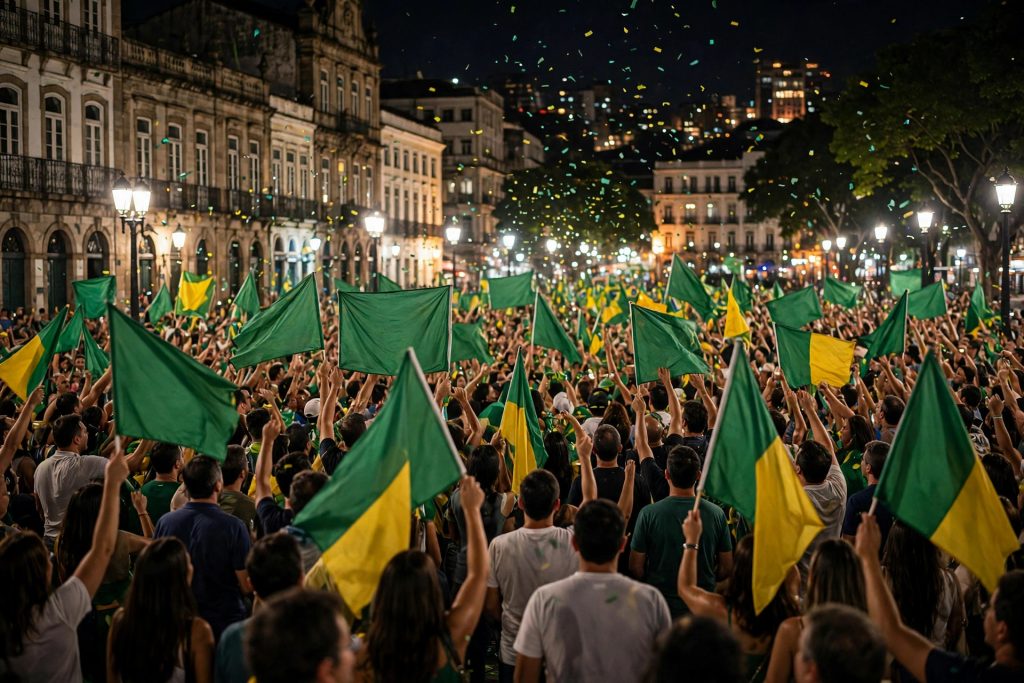
When the result became clear, crowds gathered in São Paulo, Rio de Janeiro and Belo Horizonte, waving flags, singing and dancing in streets that had been tense for much of the day. In São Paulo’s Paulista Avenue, a traditional gathering place for political celebrations, supporters chanted Lula’s name and embraced strangers. In Rio, beaches and squares filled with red flags, while in Belo Horizonte, car horns and fireworks marked the moment.
For many supporters, the celebrations were emotional as well as political. Older voters spoke about having lived through dictatorship, democratic transition and repeated economic crises, and about what it meant to see Lula return to power again. Younger voters, many voting in a presidential runoff for the first time, spoke about hope for jobs, education and a fairer distribution of opportunity.
Police and local authorities reported largely peaceful celebrations in the major cities, though they remained on alert for isolated clashes between rival groups. Lula’s team urged supporters to celebrate responsibly and to avoid provoking opponents, arguing that the task now was to govern for the whole country, including those who had voted against him.
What Happens Next Before 5 January 2027
Between the runoff and the inauguration on 5 January 2027, Brazil enters a transition period in which the outgoing and incoming teams are expected to work together on budgets, appointments and the handover of government departments. Transition teams typically meet with ministries, review ongoing programmes and prepare the first decisions of the new government, including economic measures and cabinet selections.
The transition will also be a test of political cooperation. Lula will need support in Congress to pass his early agenda, and that will require negotiation with parties that did not support him in the runoff. His choice of ministers will signal how broad he intends his government to be, and whether he prioritises loyalty, competence, regional balance or all three.
For ordinary Brazilians, the most immediate questions are practical: what happens to social payments, public-sector wages, fuel and food prices, and investment in health and education. Lula’s team has promised early action on those fronts, but the fiscal room available will depend on the budget left by the outgoing government and on the willingness of Congress to approve new spending.
What This Result Does and Does Not Settle
Lula’s victory settles who will lead Brazil for the next term, but it does not settle the deeper divisions revealed by the campaign. Brazil remains closely divided, with large parts of the electorate voting for a very different vision of the country. The new president will govern a nation in which many citizens remain sceptical of his party, his policies and his record.
Nor does the result resolve the economic and security challenges that dominated the campaign. Inflation, unemployment, crime and corruption will not disappear because of an election result, and voters will judge the new government quickly on whether daily life improves. The history of Brazilian politics suggests that honeymoon periods are short, and that governing is harder than campaigning.
What the result does offer is a chance to reset the national conversation. If Lula can build a broad governing coalition, respect democratic institutions and deliver tangible improvements, his fourth term could become a period of stability after years of turmoil. If he cannot, the divisions exposed in this election will return, stronger, at the next contest. For now, Brazil has chosen its president, and the hard work of governing begins.
