
Table of Contents
- A Weekend That Stretched Across Borders
- France at the Centre of the Movement
- Paris, Marseille and Beyond
- What Protesters Say They Want
- A Generation Shaped by Cost Pressures
- Education and Jobs
- Housing and the Cost of Living
- Beyond France: Serbia, Albania and More
- Serbia’s Long Student Movement
- Albania and the Tirana Clashes
- Germany, Britain and Italy Plan Next Steps
- How Governments Have Responded
- Security Operations and Warnings
- The Political Stakes for Macron
- Why This Wave Feels Different
- What Happens Next
A Weekend That Stretched Across Borders
Europe has seen many protest movements, but the latest wave feels unusually connected. In city after city, young people have taken to the streets with similar complaints, similar slogans and a similar sense of urgency. What began in different countries, over different local grievances, has started to look like a single, continent-wide conversation about what life is supposed to cost for a young person today, and who is listening.
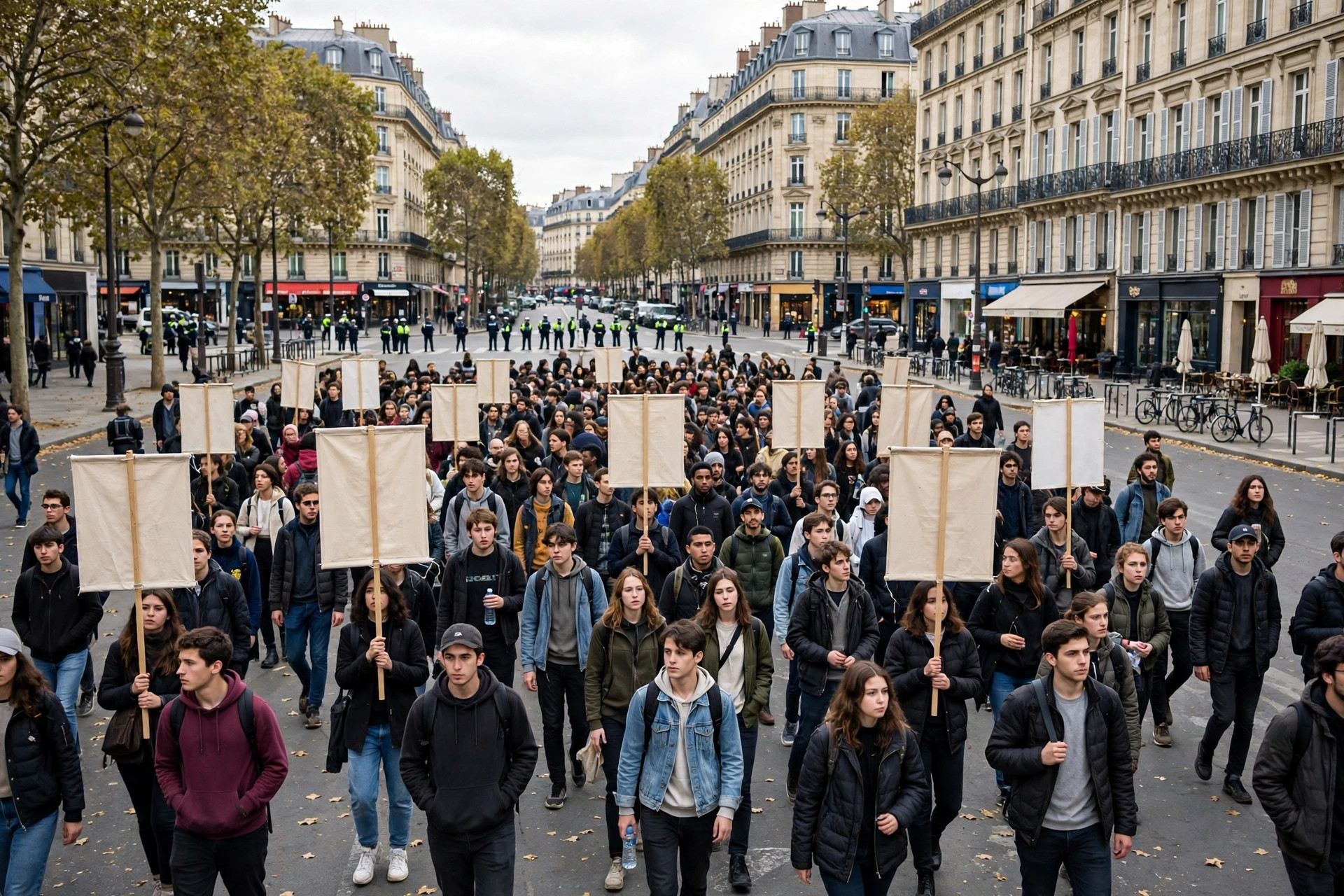
The most recent weekend brought that picture into sharp focus. Tens of thousands of demonstrators marched in France, according to CNN reporting, while protests and clashes were also reported elsewhere on the continent. In some places the marches stayed peaceful. In others, running confrontations with police, tear gas and scattered looting showed how quickly a demonstration can change character once crowds and security forces meet in a tense city centre.
For governments, the challenge is now twofold. They must keep public order on streets that are filling up again and again, while also answering a political question that does not go away when the crowds disperse: why do so many young Europeans feel that the basic bargains of adult life, an affordable education, a decent job and a home of their own, are slipping further out of reach?
This article looks at what happened over the weekend, what protesters say they want, how the movement differs from country to country, and what the next few weeks could bring.
France at the Centre of the Movement
France has been at the centre of the latest wave. Another wave of protests swept across the country on Saturday, CNN reported, with tens of thousands of demonstrators marching in cities including Paris, Marseille, Lyon, Lille, Orléans and Bordeaux. The march in Paris was organised by France’s main student union, UNEF, and was also attended by CGT, one of the country’s biggest trade unions, along with farmers, climate activists and the Yellow Vests, the movement that first emerged in 2018 during protests over fuel costs.
That mix matters. It suggests that what started largely as a student-led movement is now drawing in older workers, rural communities and climate campaigners, each bringing their own grievances but sharing a common target: a government they accuse of failing to protect living standards and public services.
The weekend did not arrive out of nowhere. It followed weeks of protests over education, job prospects and the cost of living. Those demonstrations were initially peaceful and attended mostly by students, CNN reported, before turning into the worst wave of deadly, nationwide violence in years the previous weekend. That history helps explain why the authorities treated this weekend as a major test, and why protesters themselves arrived with a sense that the stakes had risen.
Paris, Marseille and Beyond
The picture varied from city to city, and that variation tells its own story. In Paris, the march drew a broad coalition and a heavy security presence. In Marseille, France’s second city, protesters launched mortar fireworks toward police during running street skirmishes, CNN’s French affiliate BFMTV reported, and there were reports of looting in various parts of the city, including a jewellery store with smashed windows and a supermarket being pillaged.
In Bordeaux, on France’s Atlantic coast, images showed tear gas being used against protesters in the famous Place de la Bourse, while videos showed some masked protesters hurling objects at police as the tear gas drifted across the square. In Nice, dozens of far-right activists reportedly attacked people protesting peacefully on Saturday, BFMTV reported. Taken together, these reports describe a weekend in which the same national protest produced very different local scenes, peaceful marching in some places, confrontation and damage in others, and counter-protest violence in at least one.
It is important to keep that distinction in mind. A protest movement is rarely one thing. It contains students marching with banners, trade unionists demanding better conditions, and, at the edges, smaller groups prepared for confrontation. When reports focus only on the most dramatic images, the quieter majority of marchers can disappear from view, and when reports focus only on peaceful scenes, the real damage and fear felt in some neighbourhoods can be understated. Both were present this weekend, according to the reporting.
What Protesters Say They Want
At its heart, the French movement is about the cost of being young. Students have spoken about rising education costs, uncertain job prospects and a labour market that offers short contracts and low pay rather than stable careers. Trade unionists have linked those complaints to wider questions about wages, pensions and public services. Farmers and climate activists have added their own demands about rural livelihoods and environmental policy.
The leader of the far-left party France Unbowed, Jean-Luc Mélenchon, who joined the Paris march, warned that protests were likely to continue if French President Emmanuel Macron does not respond to protesters’ demands. In a post on X, he said it was time for the authorities to yield, warning that otherwise the only option left to them would soon be the exit door. Earlier on Saturday, Mélenchon told BFMTV from the front line of the demonstration that Macron risks further nationwide industrial action on November 5 unless he gives in now.
That language is deliberately strong, and it reflects a movement that believes polite requests have not worked. Whether the government agrees with that assessment is another matter, but the warning sets up a clear deadline in the minds of protesters: early November, when major trade unions in France have called for a general strike.
A Generation Shaped by Cost Pressures
To understand why young people are leading these protests, it helps to look at the pressures shaping their daily lives. Across much of Europe, the cost of housing has risen faster than wages for young workers. Rents in major cities consume a larger share of a starting salary than they did a generation ago, and buying a home feels, for many, like a distant prospect rather than a normal step into adult life.
At the same time, education has become more expensive in several countries, whether through fees, living costs or the debt students take on to get through university. Students who graduate into a labour market dominated by short-term contracts can find themselves paying off education costs while still unable to secure stable work. That combination, high costs at the start of adult life and uncertain income afterwards, is a powerful source of frustration, and it helps explain why student unions have become such effective organisers.
Education and Jobs
Education sits at the centre of the French protests, and it is a theme that echoes across the continent. Students are not only asking for cheaper courses. They are asking for a system that gives them a realistic path into work: properly funded universities, affordable accommodation, and jobs that match their qualifications. When those things feel out of reach, a protest becomes a way of saying that the system is not delivering on its promise.
Job prospects matter just as much. Young workers across Europe have grown up hearing that flexibility is the future of work, but many have experienced flexibility as insecurity: short contracts, irregular hours and little protection when work dries up. Trade unions have joined the protests in part because they see the same pattern affecting older workers too, and because they argue that a labour market built on precarious work weakens everyone, not just the young.
Housing and the Cost of Living
Housing and the cost of living complete the picture. Food, transport and energy prices have squeezed household budgets in recent years, and young people with the lowest incomes feel that squeeze first. When rent takes most of a pay cheque, there is little left for saving, for travel or for starting a family, and the sense of being stuck grows.
Climate activists who have joined the marches add another layer to this argument. They point out that the cost of living crisis and the climate crisis are linked, through energy prices, transport policy and the condition of housing. A poorly insulated flat is both expensive to heat and bad for the environment, they argue, and a public transport system that is unreliable pushes people back towards cars they can barely afford to run. These are not separate issues in daily life, even if they are often debated separately in politics.
Beyond France: Serbia, Albania and More
France may have drawn the largest crowds, but it was far from the only country where young protesters made headlines. In Serbia, the student-led protests that have shaped the country’s politics for the past two years now form the most formidable opposition to longtime leader Aleksandar Vucic, CNN reported, ahead of parliamentary elections on Sunday. That is a remarkable position for a movement that began on campuses: it suggests that sustained student protest can reshape a national political landscape, not just a single policy debate.
The Serbian experience also offers a caution and a lesson for protesters elsewhere. A movement that lasts two years has to survive fatigue, internal disagreements and government pressure. It has to keep new students joining as older ones graduate, and it has to find ways to turn street energy into political organisation. Whether the French movement follows a similar path remains to be seen, but the Serbian example shows that student protests do not always fade after a few weekends.
Serbia’s Long Student Movement
Serbia’s protests have been driven by students demanding accountability, transparency and political change, and they have drawn support far beyond university campuses. Their endurance has made them a reference point for young activists in other countries, who watch closely to see whether sustained pressure can force a government to change course or call elections it would rather avoid.
For the Serbian government, the protests present a different kind of challenge from a single weekend of marching. A movement that persists for years becomes part of the political furniture, shaping how voters think about the government long after any single demonstration ends. That is why elections matter so much in this context: they offer a test of whether street protest has translated into votes, or whether it remains a powerful but separate force in public life.
Albania and the Tirana Clashes
In Albania, protesters clashed with police during an anti-government demonstration outside the prime minister’s office in Tirana on Saturday, CNN reported. One protester was quoted as saying: “We want a revolution, we want a new government, we are not looking for any negotiations, we need a new government as soon as possible.”
That language is more sweeping than the policy demands heard in France, and it reflects a different political context. Where French protesters are largely demanding that an existing government change its policies, some Albanian protesters are demanding a change of government itself. The clash outside the prime minister’s office shows how directly that demand was aimed at the seat of power, and how quickly such a confrontation can escalate.
Germany, Britain and Italy Plan Next Steps
The calendar of planned action suggests this wave is not over. In Germany, a group calling itself “Gen Z regelt”, which translates roughly as “Gen Z’s got it”, has called for nationwide protests on October 31. Student unions in Britain and Italy are planning a day of action on November 20 to protest the rising cost of education. Major trade unions in France and Spain have called for a general strike on November 5 and November 11 respectively.
These dates matter because they turn a series of separate national protests into something that looks, at least from the outside, like a coordinated season of action. Social media helps that process: images and slogans travel across borders in minutes, and young activists in one country can borrow tactics, posters and arguments from another. Whether that amounts to a single European movement, or a set of national movements happening at the same time, is a question analysts will debate, but for governments the practical effect is similar: pressure arriving from several directions at once.
How Governments Have Responded
Governments across Europe have responded with a mixture of security measures and political messaging. In France, the scale of the security operation was striking. French authorities deployed some 70,000 police officers across the country over the weekend, according to the interior ministry, CNN reported. Specialist SWAT units, helicopters, armoured vehicles, police dogs and water cannons were all part of the operation, and the number of army soldiers that normally patrol Paris as part of the country’s counter-terrorism measures was increased to free police from stationary guard duties.
Curfews were also imposed in some cities to help maintain calm, a measure that underlines how seriously the authorities took the risk of a repeat of the previous weekend’s violence. Such measures are designed to reassure the public and deter disorder, but they also carry a political cost: a city under curfew, with armoured vehicles on its streets, can look like a government that has lost control of the normal politics of protest, even when the operation itself passes without major incident.
Security Operations and Warnings
Interior minister Laurent Nuñez issued a stark warning on Friday to anyone looking for trouble, saying the government would be uncompromising with those who engage in destruction. That message was aimed at the minority of protesters prepared for confrontation, but it also set the tone for the weekend: the government would protect the right to march peacefully, while drawing a hard line at damage and violence.
The difficulty for police on the ground is that drawing that line in a crowded, fast-moving street is rarely simple. Tear gas drifts, crowds surge, and a confrontation in one corner of a square can quickly involve people who arrived with no intention of fighting. Reports from Marseille, Bordeaux and Nice show how different those encounters can look, and they will likely fuel debate in the coming days about whether the security response was proportionate, and whether it helped or hindered peaceful protest.
The Political Stakes for Macron
For President Macron, the political stakes are high. The protests come at a moment when his government faces questions about living standards, public services and the direction of the country. A movement that brings together students, unions, farmers and climate activists is difficult to dismiss as a single interest group, and its persistence suggests that the grievances driving it run deep.
At the same time, the government will argue that it cannot simply give in to every demand made on the street, and that governing requires balancing competing interests, including those of people who did not march. That argument may convince some voters, particularly those worried about disorder, but it does little to answer the core complaint of protesters: that young people are being asked to accept a worse deal than previous generations, and that no one in power seems willing to change that.
The November 5 general strike, called by major trade unions, will be an important test. If it draws large numbers, it will show that the movement has broadened beyond students into the wider workforce. If it fizzles, the government may argue that the protest wave has peaked. Either way, the strike will shape how both sides judge the strength of the movement heading into winter.
Why This Wave Feels Different
Protests in Europe are not new, and France in particular has a long history of street politics, from the Yellow Vests to pension reform marches. So why does this wave feel different? Part of the answer lies in who is leading it. This is, in large part, a movement of people in their late teens and twenties, a generation that has grown up with social media, climate anxiety and economic uncertainty as normal parts of life.
That generation communicates differently, organises differently and frames its demands differently. It is less tied to traditional party structures and more comfortable with decentralised, fast-moving campaigns. It is also more internationally connected: a student in Lyon can watch a protest in Belgrade or Tirana in real time, and can see their own situation reflected in someone else’s story. That sense of shared experience, even across different languages and political systems, is a powerful mobilising force.
Another difference is the breadth of the coalition. When students march alone, governments can sometimes wait them out. When students march alongside trade unionists, farmers and climate activists, the movement becomes harder to ignore and harder to characterise. It also becomes harder to satisfy with a single concession, because each group brings its own demands, and a deal that satisfies one may disappoint another.
What Happens Next
The next few weeks will show whether this wave grows, stabilises or fades. The planned protests in Germany on October 31, the French general strike on November 5, the Spanish general strike on November 11 and the day of action in Britain and Italy on November 20 form a calendar that will keep the issue in the news and on the streets. Each event will be watched for its turnout, its tone and its response from governments.
In France, the key question is whether the government offers any substantive response to the demands on education, jobs and living standards, or whether it relies mainly on security measures and political messaging. In Serbia, the key question is what the parliamentary elections reveal about the political strength of the student movement. In Albania, Germany, Britain and Italy, the key question is whether local protests connect into a wider story or remain national events.
For young Europeans, the stakes are personal as well as political. They are not protesting in the abstract: they are protesting about rent, about fees, about jobs and about a future they fear will be harder than the one their parents knew. Whatever governments do next, that underlying pressure will not disappear simply because a weekend of marching ends. It will remain, in classrooms, in workplaces and in homes across the continent, until it is answered with policies that young people can feel in their daily lives.
The protests of this weekend may therefore be remembered less for any single march, and more for what they signalled: a generation that is no longer content to wait its turn, and that is prepared to take its demands to the streets, again and again, until it is heard.
